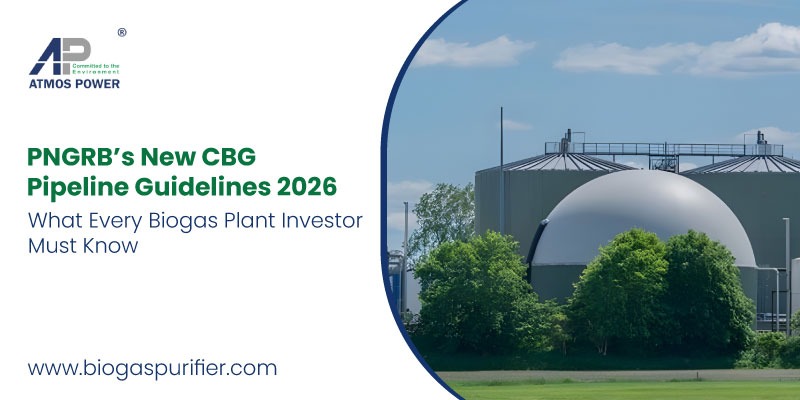
India just opened the door for biomethane to flow directly into the national gas grid. Here is a plain-English breakdown of what the new PNGRB guidelines mean for your CBG project.
In February 2026, the Petroleum and Natural Gas Regulatory Board (PNGRB) released its long-awaited guidelines for injecting Compressed Biogas (CBG) into India’s Natural Gas Pipeline (NGPL) and City Gas Distribution (CGD) networks. For anyone planning or already operating a biogas plant, this is a landmark development.
Until now, selling CBG meant bottling it into cylinders and trucking it to end users, a logistically complex and cost-heavy process. These new guidelines create a clear, legal pathway for CBG producers to inject their gas directly into the existing pipeline grid. That means access to a massive, ready-made distribution network, more stable revenue, and a much stronger investment case.
But the guidelines also come with a detailed list of technical requirements. Let us walk through the most important ones in straightforward terms.
This is the most fundamental requirement. The biomethane you inject into the grid must meet the specifications set out in two key standards: the PNGRB Access Codes for pipelines and CGD networks and IS 16087:2025, which is India’s national specification for biogas/biomethane.
In practical terms, this means your biogas upgradation system needs to deliver gas that is
Investor Note: If you are evaluating biogas upgradation technologies, this is why methane recovery rate and gas purity matter so much. Systems like Atmos Power’s VPSA technology, which guarantees over 98% methane recovery, are designed precisely to hit these kinds of quality benchmarks.
You cannot simply test your gas quality once and forget about it. The guidelines require you to install an online gas analyser or gas chromatograph (GC) that continuously monitors your gas composition at a minimum every 5 minutes.
The monitoring system must track parameters including methane (CH₄), carbon dioxide (CO₂), oxygen (O₂), hydrogen sulphide (H₂S), and moisture/dew point. All data must be stored for a minimum of 60 days, and you must give the CGD or pipeline operator real-time remote access to this data.
Additionally, your gas chromatograph needs to be calibrated weekly (or in auto-calibration mode for NGPL injection) using calibration gas sourced from an ISO 17025 accredited laboratory.
What this means for your budget: Online GC systems and dew point analysers are a significant capital cost that investors should factor in from the start. Plan for this as a non-negotiable part of your plant design, not an afterthought.
The guidelines require an automatic interlock and shut-off system that immediately stops gas injection if anything goes out of spec. Your system must automatically isolate gas flow if any of the following occur:
Fixed methane gas detectors must be installed at all potential leak points, with real-time alarms sent both locally (audio and visual) and remotely to the control room via SMS. Detectors must be calibrated every six months.
To inject gas into the pipeline, your plant needs a Pressure Regulating Skid (PRS) that steps up your gas to the pipeline’s operating pressure. For a CGD MDPE network, that is typically 3 to 5 bars. For a steel network or NGPL, it matches the pipeline’s own operating pressure.
The PRS must include a gas filter, an active-monitor dual-stream pressure reduction setup, slam-shut and creep relief valves for over- and under-pressure protection, inlet and outlet isolation valves, and a non-return valve. A controlled vent point must also be provided, with the vent stack extending at least 3 meters above nearby working platforms.
If you are delivering CBG via mobile cascades to a Decompression Unit (DCU) station, the decompression skid must also include a water preheater to compensate for the temperature drop during decompression.
All gas you inject into the grid must be measured by a certified metering skid. The guidelines require twin-stream metering (two parallel measurement streams for redundancy), calibrated at an ISO 17025-accredited laboratory to an accuracy of ±0.5%.
The metering skid must share real-time flow data with the pipeline or CGD operator. This data is also used to control your odorisation system, which must dose odorant proportionally to the actual gas flow rate.
Natural gas is odourless, so odorants like Ethyl Mercaptan or Tetra Hydro Thiophene are added so that leaks can be detected by smell. If you are injecting into a CGD network that uses MDPE piping, you are required to install an odorisation system at your plant.
The odorant you use should ideally be the same type used by your local CGD entity. Odour concentration must be regularly checked at the farthest point in the distribution system, with records maintained as per PNGRB regulations.
Note: Odorisation is not required if you are injecting directly into a steel NGPL network, since odorants are not used in high-pressure transmission pipelines.
Beyond the technical equipment, the guidelines set out a comprehensive operational and safety framework. Here is a summary of the key requirements:
Any future changes to your gas network infrastructure must go through a formal Management of Change (MoC) process and be communicated to the CGD/NGPL operator before implementation.
The PNGRB guidelines represent a maturing of India’s CBG sector. They are detailed and demanding, but that is actually good news for serious investors. Clear regulations reduce uncertainty, create a level playing field, and signal that the government is committed to making the CBG-to-grid pathway work.
The key takeaways for anyone evaluating a CBG plant investment are the following:
With over 100 CBG plant installations across Asia and a patented VPSA technology that guarantees more than 98% methane recovery, Atmos Power has the experience to help you design, build, and commission a plant that meets these new PNGRB standards. Get in touch with us at biogaspurifier.com to discuss your project.
 Certified Company