On 6 August 2026 the Union Cabinet fixed the price of Compressed Biogas at Rs.2,110 per MMBTU and backed it with an outlay of Rs.23,731 crore. Most coverage read that as a floor. Read it as a ceiling too.
If your selling price is set for the next ten years, no amount of clever marketing raises your revenue per unit. The only levers left are how much methane you pull out of your raw biogas and how much power you burn pulling it out. For anyone about to sign a plant order, that is the real story inside GOBARdhan.
GOBARdhan, the National Circular Bioenergy Scheme, runs from FY 2026-27 to FY 2035-36 under the Ministry of Petroleum and Natural Gas. It folds SATAT, the Market Development Assistance scheme for organic manure, the Biomass Aggregation Machinery scheme, pipeline infrastructure support, and Central Financial Assistance into one framework.
Those earlier schemes put more than 200 CBG plants on the ground. GOBARdhan targets close to ten times the current national CBG output.
What changed is certainty. A developer in 2023 could not tell a lender who would buy the gas, at what price, or for how long. All three now have an answer on paper.
| Component | What it gives you | The number that matters |
| Assured CBG offtake | City Gas Distribution companies must procure CBG against a notified blending obligation | 3% in FY 2026-27, 4% in FY 2027-28, 5% from FY 2028-29 in CNG transport and PNG domestic |
| Stable pricing | Government backed administered price with a minimum ten year horizon | Rs.2,110 per MMBTU |
| Capital assistance | Support for greenfield plants, feedstock aggregation assets and manure processing. Brownfield expansions qualify | Up to Rs.2 crore per TPD of installed capacity |
| Pipeline infrastructure | Cluster and standalone pipelines connecting plants to trunk lines and CGD networks | Lower evacuation cost, higher utilisation |
| Credit guarantee | Risk sharing with lenders for MSME led projects | Lower collateral, faster financial closure |
| CBG Ecosystem Challenge Fund | District level feedstock mapping, aggregation infrastructure, technology adoption, manure value addition | Ecosystem support rather than plant capex |
Four of these six components reward you for producing more gas from the same feedstock. None of them rescue a plant that produces less.
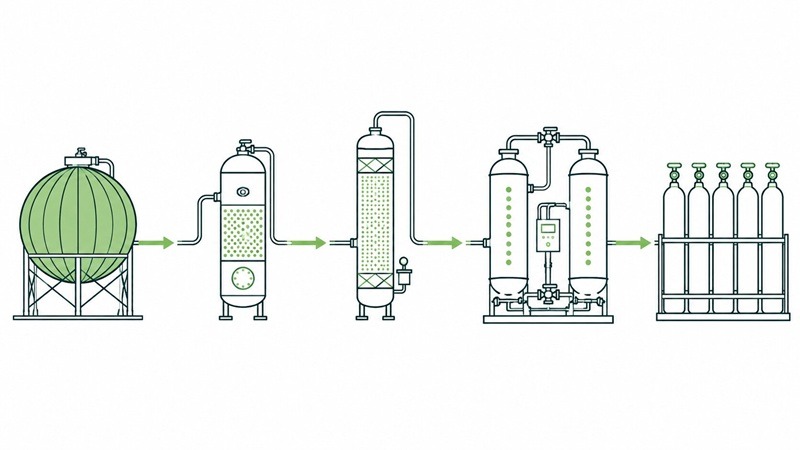
The blending obligation sends your product into a City Gas Distribution network. A CGD network does not accept gas the way a captive boiler does. Methane content, moisture dew point, hydrogen sulphide and total sulphur all get tested at the injection point, and a batch that fails does not get a discount. It gets rejected.
Plenty of operators discovered this the hard way under SATAT. They sized the digester carefully, then treated desulphurisation and drying as bolt on items to be sorted later. Later arrived as a rejected consignment.
Two stages decide whether you meet spec every day of the year:
Ask any Compressed Biogas Plant Manufacturer you shortlist to guarantee outlet specification across the full ambient range at your site, not at design point conditions on a spreadsheet.
Here is the arithmetic every developer should run before signing anything.
Take a 10 TPD plant running 330 days a year. At roughly 0.047 MMBTU per kg of CBG, that is about 474 MMBTU a day, or close to Rs.10 lakh a day at the administered price. Call it Rs.33 crore of annual revenue. These are illustrative figures, so swap in your own feedstock analysis.
Now change one variable. An upgradation system recovering 99% of the methane in your raw biogas against one recovering 92% gives you 7% more product from the same digester, the same feedstock contract and the same operating team. On Rs.33 crore, that gap is worth about Rs.2.3 crore every year.
Across the ten year life of the pricing framework, methane you vented to atmosphere costs you more than Rs.20 crore. Capital assistance on that same 10 TPD plant caps out at Rs.20 crore.
Read those two numbers next to each other. A weak upgradation system can hand back the entire capital subsidy through the vent stack, one percentage point at a time, and nothing in the scheme compensates you for it.
This is why the recovery guarantee belongs in your purchase order, with a penalty attached, rather than in the vendor’s brochure.
Separating carbon dioxide from methane is where upgradation technologies diverge and where your operating cost gets decided.
A conventional Pressure Swing Adsorption system runs at 6 to 10 bar G. A membrane system runs at 12 to 20 bar G. Compressing your entire raw gas stream to those pressures makes the feed compressor the largest single power consumer on most skids. Vacuum Pressure Swing Adsorption operates around 0.7 bar G, which changes the compressor duty and therefore the monthly bill.
When you compare quotes, ask for one figure in writing from every vendor: guaranteed specific power consumption in kWh per Nm3 of raw biogas, at your actual gas composition. Multiply it by your local industrial tariff and your annual running hours. That single line will separate the quotes faster than the headline capex will.
Reliability deserves the same scrutiny. Adsorbent life, valve cycle count and unplanned downtime all cut into a revenue stream that is now capped on the upside. A biogas purification plant in India that loses three weeks a year to maintenance loses roughly Rs.2 crore of production on the numbers above.
Assured demand, a fixed price and up to Rs.2 crore per TPD have removed the two questions that stalled CBG projects for a decade. What remains is an engineering question, and it now carries more weight than it ever did: how much of your methane reaches the meter, and what does it cost you in power to put it there.
Pick your technology on those two numbers. Everything else in the project is recoverable.
AtmosPower has built 100+ biogas upgradation installations across Asia, guarantees methane recovery above 99% using patented VPSA technology at 0.7 bar G, and delivers turnkey plants from raw gas collection through biogas compression and bottling. Send us your feedstock quantity and gas analysis and we will run the recovery and power numbers for your site. Get in touch with us for more details on: +91-6358768268 or brsingh@atmospower.net
 Certified Company