
Quick Takeaways
Two biofuel plants. Both convert a farm output into a transport fuel. Both are sold into India’s fuel supply under government biofuel policy: ethanol to oil marketing companies for blending with petrol, CBG through SATAT and, increasingly, under the mandatory CBG Blending Obligation on city gas distribution entities. Both are delivered turnkey by an EPC contractor who signs a performance guarantee.
One of those guarantees is settled in a week. The other becomes a dispute that runs for years.
The difference is not the engineering. It is what the contract is allowed to assume about the raw material.
Ethanol is guaranteeing a car’s mileage on a specified fuel. You name the octane, the client buys it from a pump, and if the mileage falls short, it is your engine.
CBG is guaranteeing that same mileage when the owner fills the tank with whatever liquid he can find locally, and the test drive takes three months.
Everything that follows is an elaboration of that sentence.
Starch is a chain of glucose molecules. When that chain is broken and the glucose fermented, one glucose molecule always yields two of ethanol and two of carbon dioxide. This is fixed stoichiometry. Nothing on site decides it.
Work it through for one tonne of maize:
| Starch content | Glucose after hydrolysis | Ethanol (51.1% of glucose by weight) | Theoretical yield |
|---|---|---|---|
| 58% | ~644 kg | ~330 kg | ~418 litres |
| 65% | ~722 kg | ~369 kg | ~468 litres |
| 72% | ~800 kg | ~409 kg | ~519 litres |
Ethanol density taken as 0.789 kg/litre. Theoretical yields assume complete conversion; no real plant achieves them.
Commercial Indian distilleries typically deliver 365 to 400 litres per tonne, and the Department of Food and Public Distribution uses 380 litres per tonne of maize as its planning norm. Against the theoretical figures above, that’s roughly 80 to 90% of theory, depending on grain quality and process configuration.
Now look at what that spread means. Indian maize is variously reported at 58% to 72% starch, and distilleries have reported consignments at the low end. That range alone moves the theoretical yield by about 100 litres per tonne, a quarter of the entire output.
Which is precisely why an ethanol EPC contract specifies starch content.
If it did not, the contractor would carry that 100 litre swing himself, and every shortfall claim would become an unresolvable argument about whether the grain or the plant was at fault. Sound familiar?
What makes the ethanol guarantee workable is not that grain is uniform. It’s that grain quality is defined in the contract and measurable in an afternoon. Starch content of a maize sample is a routine laboratory determination. So the exchange can be written cleanly:
You supply maize at 65% starch. I deliver 385 litres per tonne, at a stated steam and power consumption, to IS 15464 purity.
The contractor is still guaranteeing several things: yield, utility consumption, product purity, plant capacity. But every one of them is measured against a defined input that both parties agreed to before the plant was built.
Theoretical methane yields for biogas substrates certainly exist. Buswell’s equation, formulated in the 1930s, predicts methane and carbon dioxide output from a substrate’s elemental composition, and it works.
The problem is different: there is no single practical equation that predicts full-scale biogas output from a routine feedstock specification with anything like the same reliability.
The reason is that you don’t know what’s in the truck, and the specification you can afford to run on every load doesn’t capture what matters.
Press mud from one sugar mill is not press mud from the next. It varies with cane variety, clarification practice, and how long it sat in the yard. Napier grass cut at 60 days is a different substrate from the same grass cut at 90 days. Cattle dung changes with what the cattle were fed that season.
The obvious answer is to specify Volatile Solids, or VS: the organic, combustible fraction of the feed. It’s the right starting point, but on its own it isn’t enough. VS tells you how much organic matter arrived. It doesn’t tell you how much of it the bacteria can actually digest.
Lignin, the woody structural material in plants, is counted as volatile solids but is highly resistant to anaerobic biodegradation, and researchers studying digester performance have linked lignin content within VS to reduced methane potential. Two consignments with identical VS can therefore produce very different gas volumes. The routine input test does not predict the output.
And the conversion isn’t being performed by chemistry alone. It’s being performed by a living, mixed population of bacteria and archaea that responds to how it’s treated. Load it too quickly and volatile fatty acids accumulate faster than the methanogens can consume them. Feed it a high nitrogen substrate, and free ammonia begins to inhibit those same organisms. Neither failure announces itself on the day it starts.
This is the part that decides who pays.
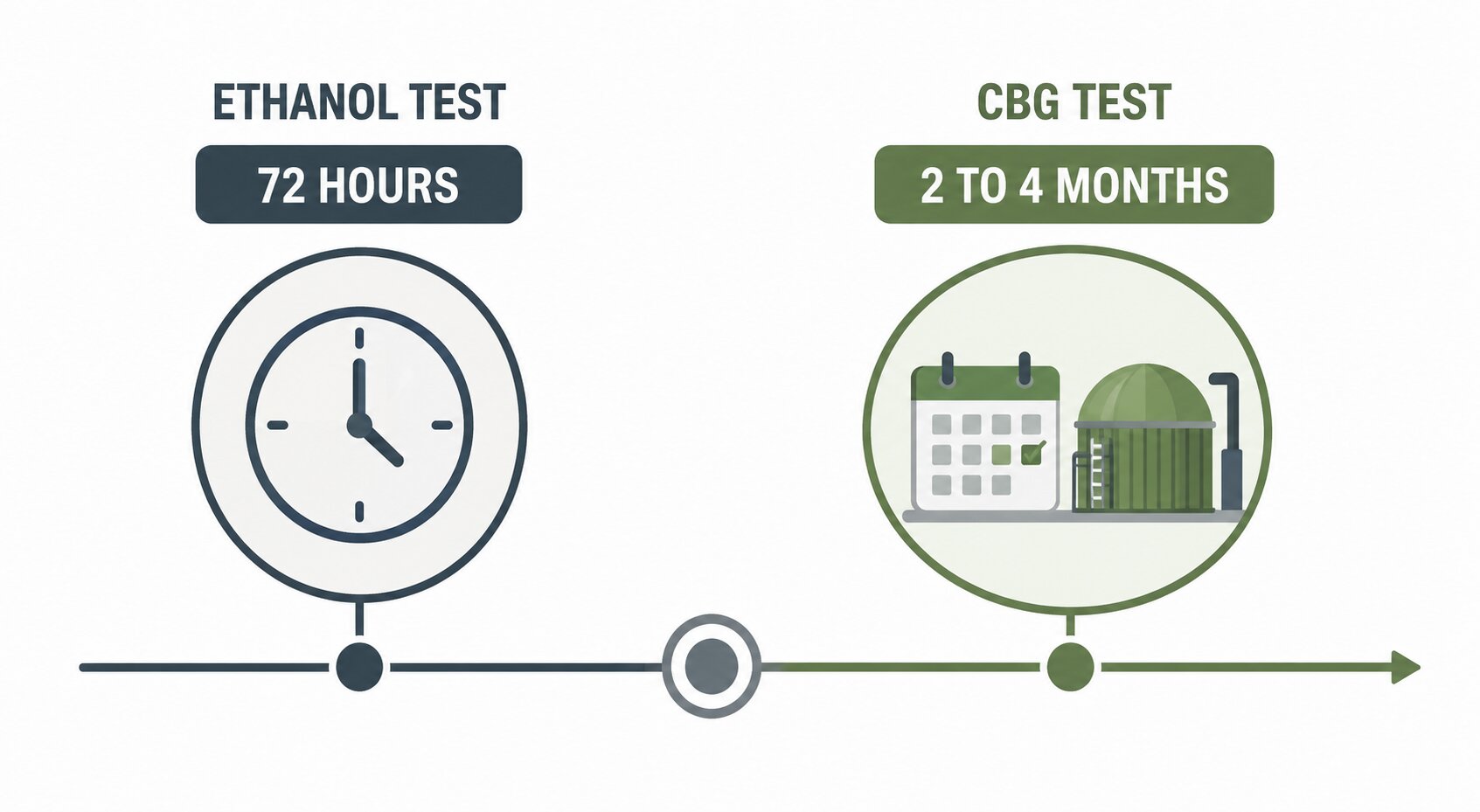
Ethanol. Run 72 hours. Weigh the grain in, meter the litres out, check purity. If the result disappoints, adjust and run it again tomorrow. The argument closes inside a week, on evidence both parties watched being collected.
CBG. A newly commissioned digester needs several hydraulic retention times to reach stable performance. As a working rule, two to three HRTs, which for a typical 25 to 40 day HRT means roughly two to four months from seeding, and longer where the inoculum is poor, the substrate is difficult, or loading is ramped cautiously.
During that window the client has delivered perhaps fifty separate truckloads, from several sources, in changing weather.
At the end of it, gas output is 15% below the guaranteed figure.
Was that the digester design, or was it the feedstock? In most CBG contracts as they’re written today, neither party can prove the answer. The EPC points to substrate variability. The owner points to the guarantee. And unlike a fermentation batch, a disturbed digester can’t simply be rerun tomorrow: de-loading and re-ramping costs several more weeks before a second test can even begin.
That combination, an unprovable attribution and a test that can’t be cheaply repeated, is what turns a technical shortfall into a commercial dispute.
The ethanol EPC has no superior technology for managing raw material risk. His feedstock varies too. What he’s done is define his input inside the contract, in terms both parties can measure, and accept liability only for the gap between that defined input and the finished product.
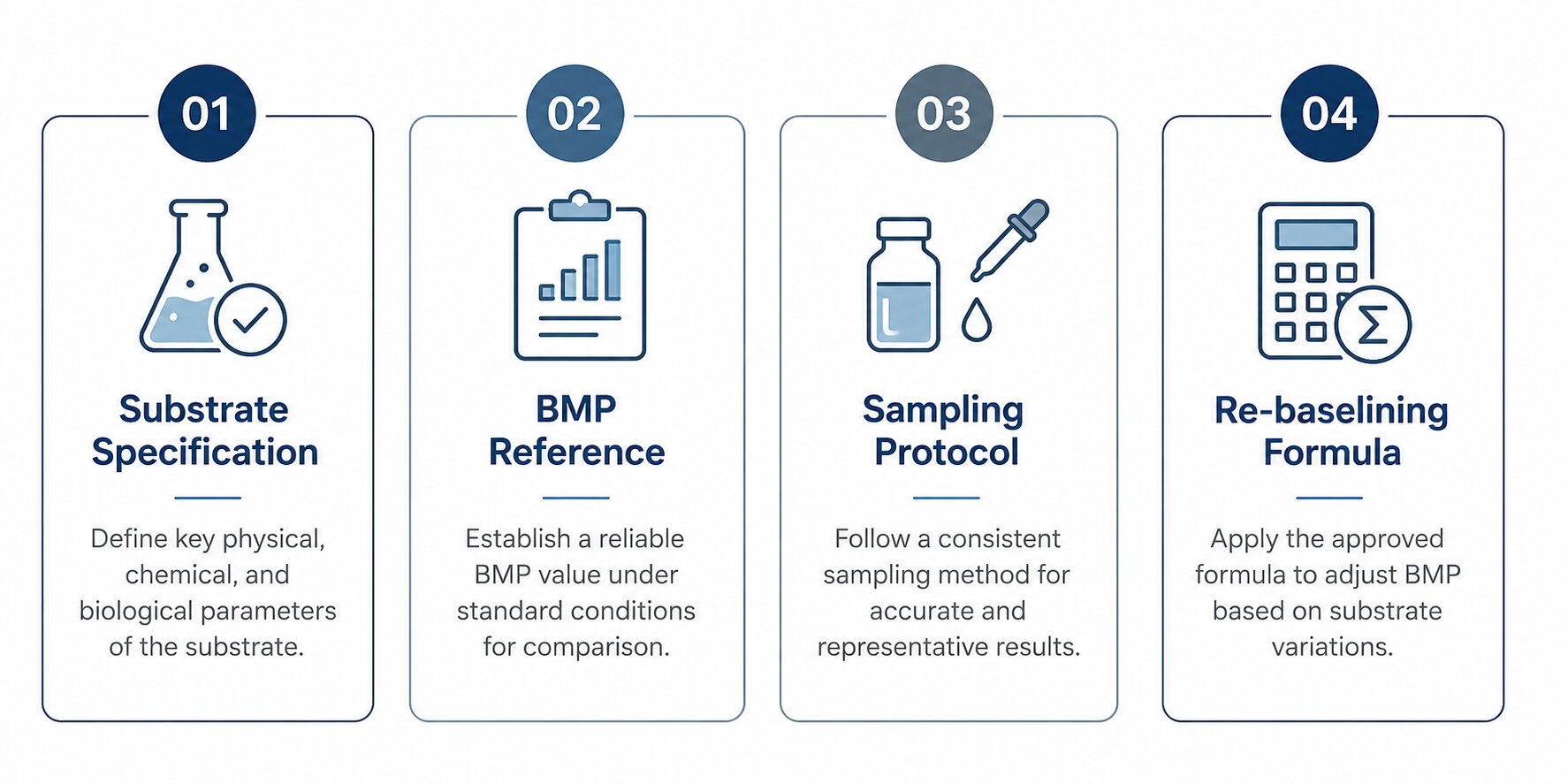
Nothing stops a CBG contract from being written the same way. Four elements do most of the work.
1. A substrate specification, not a substrate name. Not “press mud.” Instead: total solids, volatile solids, VS as a percentage of TS, moisture, C:N ratio, an estimate of the non-degradable fraction, and limits on sand, grit, plastics and inhibitory contaminants.
2. A biomethane potential reference, not VS alone. A BMP (biochemical methane potential) assay on a pre-agreed reference sample establishes the methane potential of that specific substrate under controlled laboratory conditions. It’s a reference, not a forecast: full-scale plants operating at finite retention time, with real substrate heterogeneity and reaction kinetics, won’t reproduce laboratory BMP. So the guarantee should be expressed as an agreed fraction of the BMP reference, under specified operating conditions. That’s a statement about the plant’s performance, rather than an absolute gas figure that silently carries the client’s feedstock risk.
3. A sampling protocol both sides sign before commissioning. Frequency, sampling point, method, custody of samples, nominated laboratory, and how disputed results get retested. Agreed in advance, when nobody yet has a position to defend.
4. A re-baselining formula that cuts both ways. If the measured feed falls outside specification, the guaranteed output adjusts by a stated calculation rather than by negotiation after the fact. Equally, the guarantee should hold only where the plant has been operated within the agreed envelope: organic loading rate, temperature, retention time, recirculation. A contractor can’t fairly invoke feedstock variation to excuse a plant that was operated outside its design parameters, and an owner shouldn’t have to accept that he can.
None of this makes anaerobic digestion easier. The biology remains slower, more variable and less forgiving than yeast fermentation, and it always will be. A digester will always take months to tell you what a fermenter tells you in three days.
What these four clauses change is the character of the conversation when performance falls short. Instead of “your plant doesn’t work” against “your feedstock was poor” (two unfalsifiable assertions), you have a sample record, a specification, an operating log and an agreed formula.
It doesn’t make biology more predictable. It makes the argument decidable.
For a project developer, that’s worth more than any equipment warranty in the document. The most expensive line in a CBG contract is rarely the plant. It’s the year of dispute that follows an undefined guarantee.
AtmosPower Pvt. Ltd. is a Compressed Biogas Plant Manufacturer that designs and delivers turnkey compressed biogas plants and holds patents in India and Europe for two-stage VPSA biogas upgradation technology. To talk through a performance guarantee for your own CBG project, reach the team at brsingh@atmospower.net or +91-6358768268.
 Certified Company